
Sciatica can cause lower back pain that travels to the hip, buttock, thigh, calf, or foot, affecting sitting, walking, driving, sleep, and daily movement. This blog explains sciatica symptoms, common causes, red flags, and how assessment-based physiotherapy may support sciatica-related lower back and leg pain in Dubai.

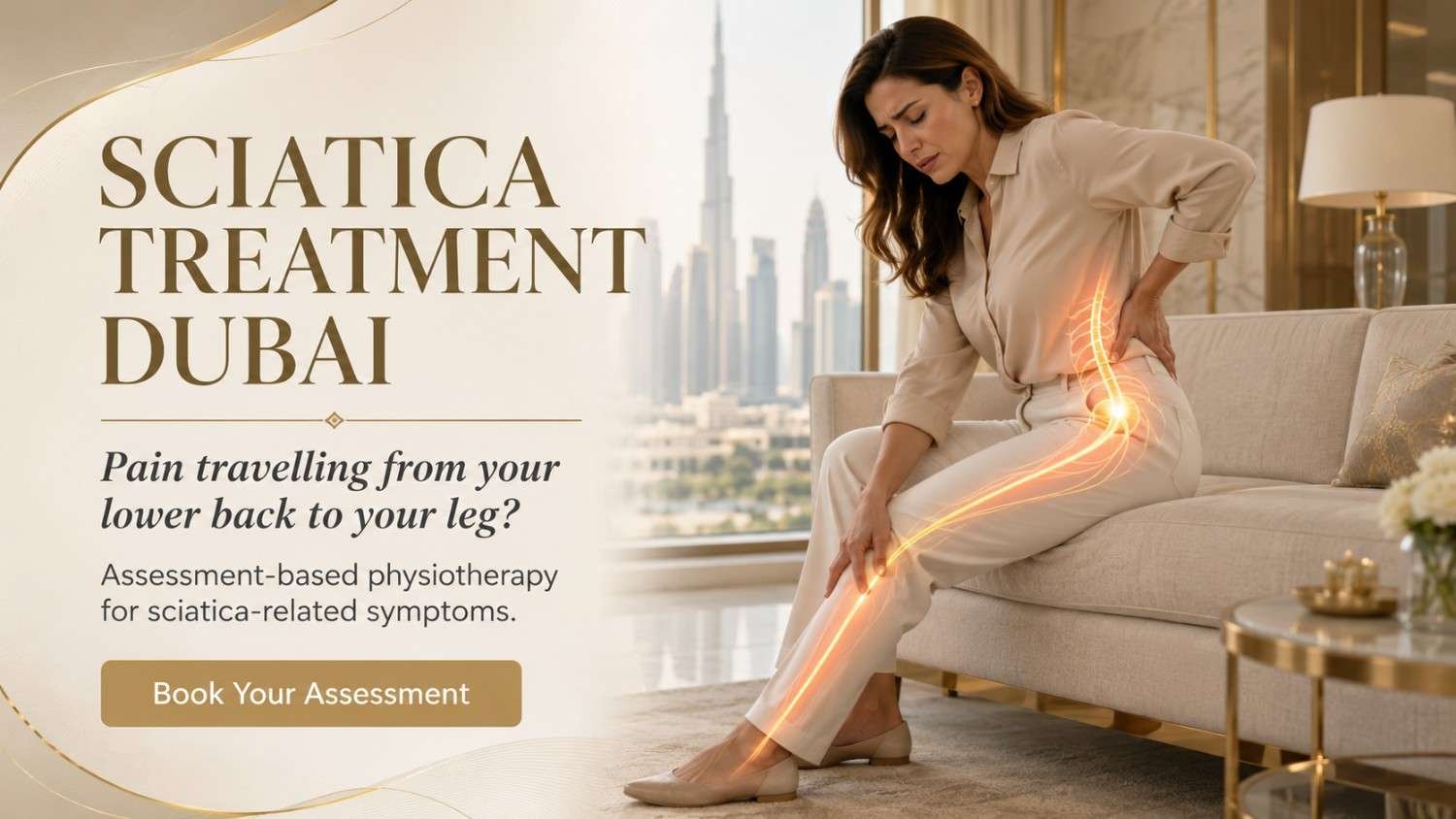
Searching for Sciatica Treatment Dubai usually starts when pain is no longer limited to the lower back. Many people begin to feel discomfort travelling from the lower back into the hip, buttock, thigh, calf, or foot. For some, it feels like a sharp line of pain. For others, it may feel like burning, tingling, numbness, heaviness, or an electric-shock type sensation down the leg.
Sciatica can affect daily life in many ways. Sitting at work, driving in Dubai traffic, walking for long periods, sleeping comfortably, bending forward, lifting, travelling or going to the gym may become difficult. This is why many patients look for Sciatica Treatment Dubai when the problem begins to interfere with the normal activities of daily life.
At PhysioVeda Medical Center Dubai, the approach to sciatica is based on assessment, symptom behaviour, movement quality, and individual tolerance. The aim is not to apply the same routine to every patient. The first step is to understand why the sciatic nerve or related nerve roots may be irritated, and then plan physiotherapy accordingly.
Sciatica is commonly linked with irritation or compression of the sciatic nerve, which runs from the lower back toward the feet. The NHS describes sciatica as irritation or compression of the sciatic nerve, with symptoms commonly affecting the buttock and the back of one leg, sometimes reaching the foot and toes.
If you are looking for Sciatica Treatment Dubai, a proper physiotherapy assessment can help you understand whether your leg pain is likely related to sciatica, another lower back condition, hip-related pain, or a deep gluteal muscle issue.
What Is Sciatica Treatment Dubai?
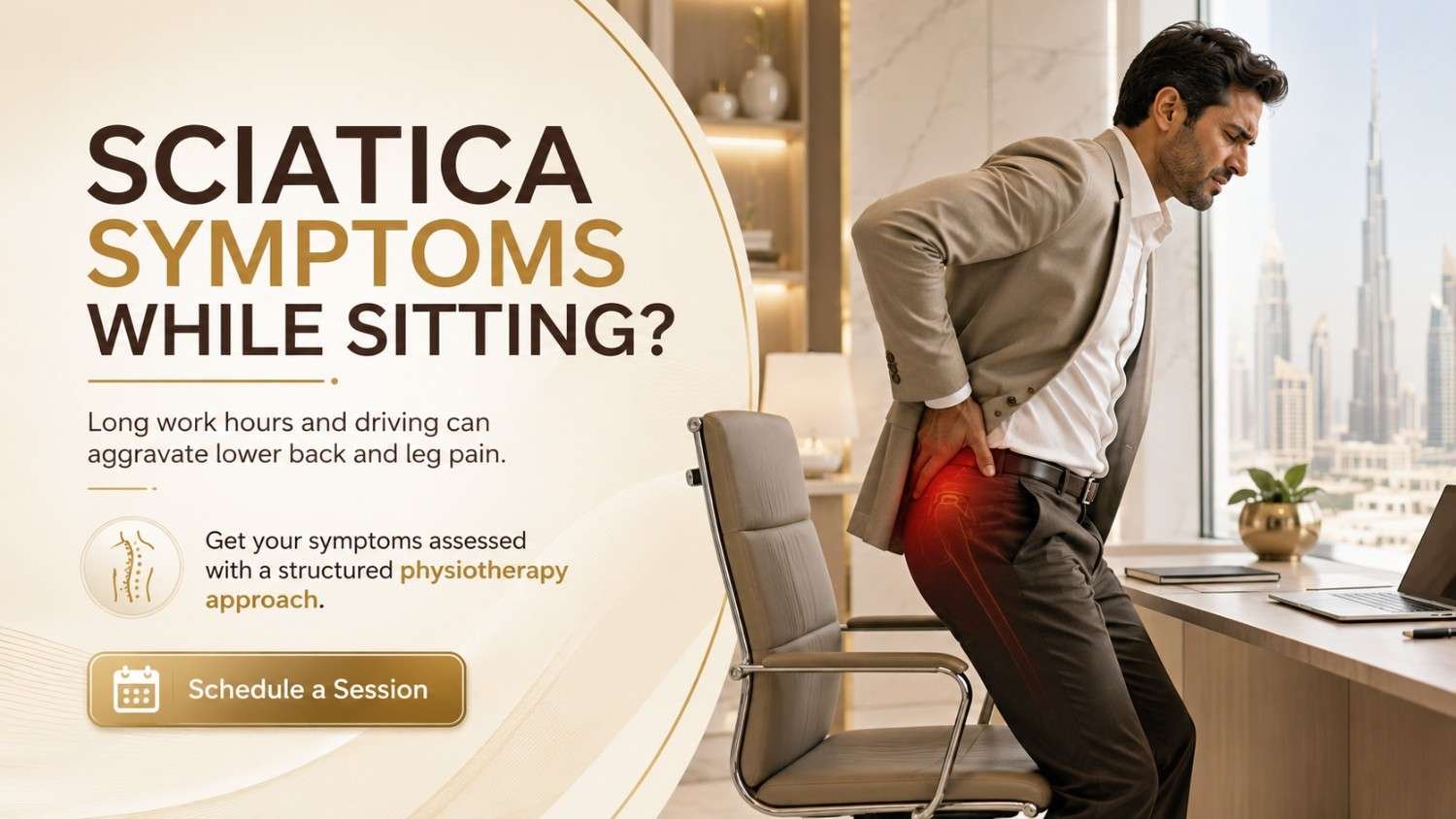
Sciatica Treatment Dubai. Sciatica refers to a pattern of symptoms linked with irritation of the sciatic nerve or the nerve roots in the lower spine. The sciatic nerve is one of the major nerves of the body. It travels from the lower back, through the buttocks, and down the leg. When this nerve or its related nerve roots become irritated, symptoms may travel along that pathway.
Sciatica is not always a diagnosis by itself. It is often a symptom pattern. This means that the real clinical question is not only “Do I have sciatica?” but also “What is irritating the nerve?”
Some people develop sciatica because of a lumbar disc issue. Some may have symptoms related to spinal narrowing, nerve root irritation, prolonged sitting, poor loading habits, hip stiffness or deep gluteal muscle irritation. Some conditions can also mimic sciatica even when the sciatic nerve is not the main source of the pain.
This is why Sciatica Treatment Dubai should begin with an assessment rather than random exercises, repeated stretching or passive treatment alone. The right plan depends on the cause, severity, symptom behaviour and clinical findings.
Low back pain is a very common global health issue. The World Health Organization reports that low back pain affected 619 million people globally in 2020 and is a major reason people may benefit from rehabilitation. Because sciatica is often connected with lower back and nerve-related symptoms, proper guidance becomes important when pain starts affecting function.
Common Symptoms That May Need Sciatica Treatment Dubai
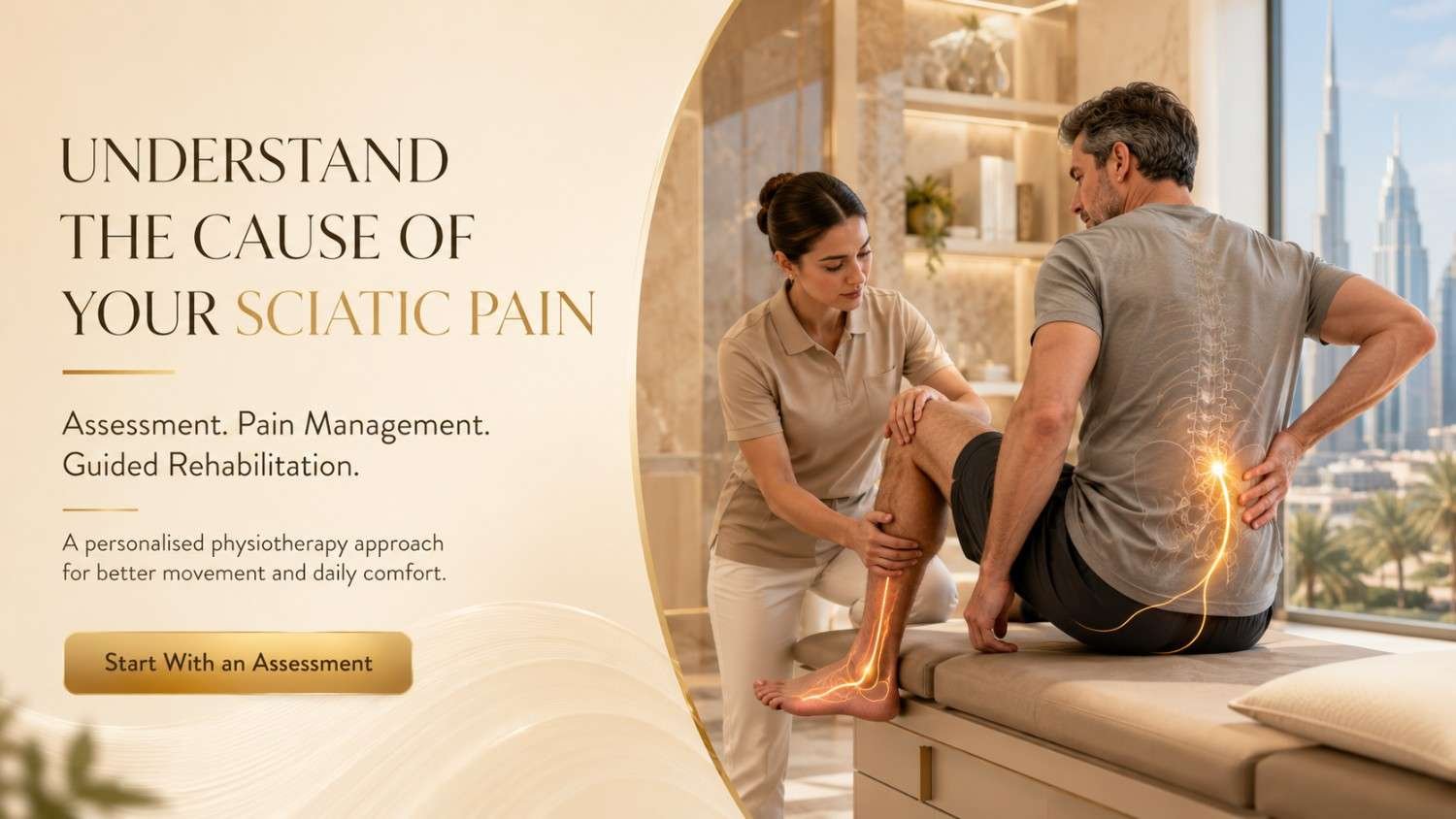
Sciatica symptoms can vary from person to person. Some patients feel mild discomfort that comes and goes. Others experience stronger leg symptoms that make sitting, walking or sleeping difficult.
You may consider a physiotherapy assessment for Sciatica Treatment Dubai if you notice symptoms such as lower back pain with leg pain, buttock pain on one side, pain travelling down the thigh or calf, tingling in the foot, numbness, burning pain, sharp pain while bending, pain while sitting for long periods, pain while driving, or discomfort that increases when coughing or sneezing.
The NHS notes that sciatica symptoms may include sharp or burning pain down the back of the leg, tingling, numbness and weakness, and symptoms can worsen with movement, sneezing or coughing.
A common sign of sciatica is that leg pain feels more noticeable than back pain. Some patients say, “My back is painful, but my leg is the bigger problem.” Others may not feel much back pain at all but still experience pain, tingling or numbness down the leg.
However, not every leg pain is true sciatica. Pain from the hip joint, sacroiliac joint, gluteal region, or deep hip muscles may sometimes travel down the leg and feel similar. This is why clinical testing is important before starting any Sciatica Treatment Dubai plan.
When Is Sciatica Treatment Dubai Serious?

Most sciatica symptoms can be assessed in a physiotherapy or medical setting, but certain symptoms need urgent medical attention. These should not be managed with exercises or physiotherapy alone.
Seek urgent medical care if you have loss of bladder or bowel control, numbness around the groin or saddle area, severe or worsening weakness in both legs, sciatica symptoms on both sides, difficulty starting urination, inability to urinate, or loss of control when passing urine or stool.
The NHS advises immediate emergency care if sciatica occurs on both sides, if severe or worsening weakness or numbness affects both legs, or if bladder, bowel or saddle-area symptoms are present. These signs may indicate a serious back problem that needs hospital-level care.
This section is important for every Sciatica Treatment Dubai blog because patient safety comes first. If symptoms are severe, rapidly worsening or associated with neurological changes, do not wait for routine physiotherapy. Medical evaluation should come first.
Common Causes of Sciatica Treatment Dubai
Understanding the cause is central to planning Sciatica Treatment Dubai. Two people may both have pain travelling down the leg, but their treatment needs may be different.
1. Lumbar Disc Irritation
A disc in the lower spine may irritate or place pressure on nearby nerve roots. This can create pain that travels into the buttock, thigh, calf or foot. Disc-related sciatica may worsen with sitting, bending forward, lifting or coughing, depending on the individual pattern.
2. Lumbar Nerve Root Irritation
Nerve roots exit the spine through small openings. If a nerve root becomes irritated due to inflammation, narrowing, disc changes or joint-related changes, symptoms may follow the path of that nerve down the leg.
3. Spinal Stenosis
Spinal stenosis refers to narrowing around the spinal canal or nerve pathways. In some cases, symptoms may feel worse with standing or walking and may reduce with sitting or bending slightly forward. This pattern needs careful assessment because the exercise approach may differ from other types of sciatica.
4. Deep Gluteal or Piriformis-Related Irritation
Sometimes pain may arise from the deep buttock region where muscles and nerves are closely related. This can create sciatica-like symptoms. Treatment may need to focus on hip mobility, gluteal control, soft tissue sensitivity and movement patterns.
5. Repeated Sitting and Poor Loading Habits
Dubai lifestyle can involve long sitting hours, extended driving, desk work, air travel, gym training and sudden increases in physical activity. These factors may not directly cause sciatica in every person, but they can contribute to irritation or aggravation in some cases.
6. Weak Core, Hip or Gluteal Control
Poor control around the lower back, pelvis and hips can place repeated stress on the lumbar spine and surrounding structures. Over time, this may contribute to recurring lower back and leg symptoms.
Because there are different causes, Sciatica Treatment Dubai should be planned after understanding the patient’s symptoms, lifestyle, movement habits and physical examination findings.
Why Assessment Matters Before Sciatica Treatment Dubai
A common mistake is starting treatment without understanding the source of symptoms. Some patients try aggressive stretching, random YouTube exercises, massage only, self-cracking, heavy gym workouts or complete bed rest. These may not be suitable for every case.
At PhysioVeda Medical Center Dubai, physiotherapy assessment for sciatica may include a detailed history, pain pattern analysis, lower back movement testing, hip and pelvis assessment, walking observation, posture review, straight leg raise testing, slump testing, strength screening, sensation screening and functional movement assessment.
The purpose is to understand whether symptoms appear more disc-related, nerve-root related, stenosis-related, hip-related, deep gluteal-related or movement-pattern related. This helps guide a more suitable Sciatica Treatment Dubai plan.
NICE guidelines for low back pain and sciatica recommend considering alternative diagnoses, using assessment to guide management and not routinely offering imaging in non-specialist settings unless clinically required. This supports the idea that assessment should come before assumptions.
A scan may be needed in some cases, especially if symptoms are severe, worsening or neurologically concerning. But for many patients, the first step is a clinical assessment to understand symptoms, function and risk factors.
Our Physiotherapy Approach for Sciatica Treatment Dubai
At PhysioVeda Medical Center Dubai, Sciatica Treatment Dubai is planned around the patient’s condition rather than a fixed routine. The plan may include pain management, manual therapy, movement correction, nerve mobility work, strengthening and lifestyle education depending on assessment findings.
1. Pain and Symptom Management
The first phase focuses on reducing irritability and helping the patient move more comfortably. This may include education, gentle mobility, posture guidance, activity modification, heat or supportive modalities where suitable, and advice on how to sit, walk and sleep with less aggravation.
The goal is to calm the sensitive system enough to begin active rehabilitation. Pain management is not the end of treatment. It is the first stage.
2. Manual Therapy Where Suitable
Manual therapy may include soft tissue techniques, lumbar or hip mobilisation and gentle hands-on treatment depending on the patient’s tolerance. NICE recommends manual therapy only as part of a treatment package that includes exercise, not as a standalone approach.
This means massage or hands-on work may support movement and comfort, but long-term progress usually also requires exercise, strength, posture education and activity correction.
3. Nerve Mobility Work
Some patients may benefit from carefully graded nerve mobility exercises. These are not aggressive stretches. They are controlled movements designed to improve tolerance of the nerve pathway. If done too forcefully, nerve symptoms may become more irritated.
For this reason, nerve mobility should be selected according to assessment findings and patient response.
4. Core and Glute Strengthening
A structured Sciatica Treatment Dubai plan often includes strengthening around the lower back, deep core, pelvis and hips. Better control in these areas may reduce repeated stress on the lumbar spine and improve movement confidence.
Exercises may include low-level core activation, glute bridges, hip control drills, modified side supports, bird-dog variations, step control, hip hinge practice and progressive strengthening based on tolerance.
5. Hip and Pelvic Mobility
Stiffness around the hips and pelvis can influence lower back loading. Physiotherapy may include mobility work for the hip flexors, gluteal region, hamstring region and lower back depending on the patient’s movement pattern.
The focus is not to stretch aggressively. The focus is to improve controlled movement.
6. Posture and Daily Activity Education
For desk workers, drivers and active individuals in Dubai, education is an important part of Sciatica Treatment Dubai. Patients may need guidance on sitting breaks, driving posture, sleeping position, lifting technique, gym modification and return to normal daily activities.
NICE recommends advice and information tailored to the patient’s needs, including encouragement to continue normal activities where appropriate.
Sciatica Treatment Dubai for Desk Workers
Many Dubai residents sit for long hours at a desk, attend back-to-back meetings, work on laptops or spend extended time in office chairs. Sitting can increase symptoms for some sciatica patients, especially if the lower back and hips remain in one position for too long.
For desk workers, Sciatica Treatment Dubai may include workstation correction, chair and screen adjustment, lumbar support guidance, regular movement breaks, hip mobility drills, gentle walking routines and core activation exercises.
A practical approach may involve changing position every 30 to 45 minutes, avoiding long uninterrupted sitting, keeping the feet supported, adjusting the screen to eye level and using a chair that supports the lower back.
The NHS advises people with sciatica to carry on with normal activities as much as possible and avoid sitting or lying down for long periods. This advice is especially relevant for office workers who sit for most of the day.
Sciatica Treatment Dubai for Drivers
Driving in Dubai can involve long periods of sitting, especially for professionals who travel across the city for work. Car seats, vibration, traffic time and poor lumbar support may increase symptoms for some patients.
For drivers, Sciatica Treatment Dubai may include driving posture correction, seat distance adjustment, lower back support, avoiding sitting with a wallet in the back pocket, taking movement breaks during long drives and doing gentle mobility before and after travel.
A small change in sitting angle or lumbar support can sometimes make driving more manageable. However, if leg pain, numbness or weakness worsens while driving, a clinical assessment is important.
Sciatica Treatment Dubai for Gym-Goers
Many patients searching for Sciatica Treatment Dubai are active people who train in the gym. Sciatica may appear after heavy squats, deadlifts, leg press, running, sudden loading or poor recovery between sessions.
During the painful phase, it may be necessary to temporarily modify heavy lifting, deep bending, loaded spinal flexion or exercises that increase leg symptoms. This does not mean the patient must stop all activity. It means training should be adjusted according to symptom behaviour.
Physiotherapy may include technique review, hip hinge retraining, glute activation, core control, progressive loading and a graded return to fitness. The aim is to support safe movement and reduce repeated irritation.
Returning to gym activity should be gradual. If an exercise increases sharp leg pain, numbness or symptoms travelling further down the leg, it should be reviewed.
Exercises Used in Sciatica Physiotherapy
Exercises for sciatica should be chosen after assessment. What helps one patient may aggravate another. This is why Sciatica Treatment Dubai should not be based only on generic exercise lists.
Common exercise categories may include gentle spinal mobility, pelvic tilts, walking intervals, nerve sliders, core activation, glute strengthening, hip mobility, posture control and progressive functional training.
NICE recommends considering exercise programmes for low back pain with or without sciatica, taking the person’s needs, preferences and capabilities into account.
Examples may include:
Gentle mobility exercises such as pelvic tilts, cat-camel movements and lumbar rocking.
Nerve mobility exercises such as sciatic nerve sliders or slump sliders, performed gently and only when suitable.
Core stability exercises such as abdominal bracing, dead bug variations, bird-dog variations and modified side plank work.
Hip and glute exercises such as glute bridges, clamshells, hip abduction work, step-ups and hip hinge drills.
Return-to-gym exercises such as squat pattern correction, deadlift mechanics, lunge control and progressive resistance training.
Exercises should not create worsening sharp leg pain, increasing numbness or progressive weakness. If symptoms worsen repeatedly with a movement, that exercise should be stopped and reviewed by a physiotherapist.
What to Avoid During Sciatica Treatment Dubai Pain
During sciatica symptoms, some habits may increase irritation or delay improvement. Avoiding these can support the treatment plan.
Avoid prolonged sitting without movement breaks, especially if sitting increases leg pain.
Avoid aggressive hamstring stretching, because what feels like hamstring tightness may sometimes be nerve sensitivity.
Avoid heavy deadlifts, squats or leg press during the acute painful stage if these movements increase symptoms.
Avoid repeated bending if it sends pain further down the leg.
Avoid self-cracking or forceful manipulation without clinical guidance.
Avoid complete bed rest unless advised by a healthcare professional. Gentle movement is usually more useful for many patients.
Avoid following random online exercises without knowing your type of sciatica.
Avoid ignoring worsening numbness, weakness or bladder and bowel symptoms.
The NHS advises gentle movement and normal activity where possible, and also highlights that prolonged sitting or lying down is not usually helpful for sciatica.
How Long Does Sciatica Physiotherapy Take?
The timeline for Sciatica Treatment Dubai varies from person to person. Some patients notice improvement in comfort and movement earlier, while others need a longer rehabilitation plan. It depends on the cause, severity, duration of symptoms, nerve sensitivity, lifestyle, work demands, strength, mobility, sleep, activity level and consistency with home guidance.
The NHS states that sciatica usually improves in a few weeks to a few months but can last longer and may return in some people.
A realistic physiotherapy plan may move through phases. The first phase focuses on reducing symptom irritability. The second phase improves mobility and control. The third phase builds strength and confidence. The final phase focuses on return to daily activity, work, driving, gym or sport.
Stopping treatment as soon as pain reduces may leave the underlying movement or strength issues unaddressed. For recurring sciatica, long-term management is usually about building better capacity and reducing repeated irritation.
Why Choose PhysioVeda Medical Center for Sciatica Treatment Dubai?
PhysioVeda Medical Center Dubai provides assessment-based physiotherapy for patients with lower back pain, leg pain and sciatica-related symptoms. The focus is on understanding the patient’s condition, identifying contributing factors and planning a suitable treatment approach.
For Sciatica Treatment Dubai, the physiotherapy plan may include clinical assessment, pain management, manual therapy where suitable, exercise therapy, posture guidance, nerve mobility work, core and hip strengthening, ergonomic advice and long-term self-management education.
The approach is suitable for desk workers, drivers, gym-goers, active adults and patients whose sciatica symptoms are affecting daily activities. Home physiotherapy may also be considered for patients who are unable to visit the clinic, depending on suitability and availability.
At PhysioVeda, the treatment plan is not based only on the painful area. The assessment also considers how you sit, stand, walk, bend, drive, work and exercise. This helps create a more complete understanding of why symptoms may be recurring.
If you are searching for Sciatica Treatment Dubai, booking a physiotherapy assessment can be a practical first step to understand your symptoms and begin a structured care plan.
Frequently Asked Questions About Sciatica Treatment Dubai
What is sciatica?
Sciatica is a pattern of pain, tingling, numbness or weakness that may travel from the lower back or buttock down the leg. It usually happens when the sciatic nerve or related lower back nerve roots become irritated or compressed. The exact cause should be assessed before starting treatment.
When should I consider Sciatica Treatment Dubai?
You may consider Sciatica Treatment Dubai if pain travels from your lower back or buttock into the leg, affects sitting, walking, driving, sleeping or daily activities, or if symptoms keep returning. If there is severe weakness, bladder or bowel change, or saddle-area numbness, urgent medical care is required.
Can physiotherapy support sciatica management?
Physiotherapy may support sciatica management by addressing movement, posture, nerve mobility, strength, hip control, daily activity habits and pain behaviour. Suitability depends on the assessment findings, cause of symptoms and patient tolerance.
Is massage enough for sciatica?
Massage may reduce muscle tension in some patients, but sciatica usually needs a broader approach. A complete physiotherapy plan may include assessment, education, exercise, nerve mobility work, strength training and activity modification. NICE recommends manual therapy only as part of a treatment package that includes exercise.
Do I need an MRI for sciatica?
Not every sciatica patient needs immediate imaging. NICE recommends not routinely offering imaging in non-specialist settings for low back pain with or without sciatica. Imaging may be considered in specialist settings when the result is likely to change management.
What exercises are suitable for sciatica?
Suitable exercises depend on the patient’s symptoms and assessment. Common categories include gentle mobility, nerve sliders, core activation, glute strengthening, hip mobility and progressive functional training. Exercises should not repeatedly worsen leg pain, numbness or weakness.
Can sciatica come back?
Yes, sciatica can return in some people. The NHS notes that if a person has had sciatica before, there is a chance it may happen again. Regular activity, safe lifting technique, sitting posture and appropriate exercise may reduce recurrence risk.
Conclusion for Sciatica Treatment Dubai
Sciatica can affect sitting, walking, driving, sleeping, work, and exercise. It can feel worrying because the pain often travels below the back and into the leg. However, the right first step is not guessing or starting random exercises. The right first step is understanding the source and behaviour of symptoms through proper assessment.
If you are looking for Sciatica Treatment Dubai, PhysioVeda Medical Center Dubai provides assessment-based physiotherapy for sciatica-related symptoms. Treatment may include pain management, manual therapy where suitable, nerve mobility work, strengthening, posture correction, ergonomic advice and progressive rehabilitation.
Every patient’s sciatica pattern is different. That is why treatment should be planned according to clinical findings, patient tolerance and daily life needs.
Book a physiotherapy assessment at PhysioVeda Medical Center Dubai to understand your sciatic nerve pain pattern and receive a suitable treatment plan based on your condition.
Disclaimer
This blog is for general educational awareness only. It does not replace medical consultation, diagnosis or emergency care. Treatment suitability depends on individual assessment. If you experience bladder or bowel changes, saddle-area numbness, severe or worsening weakness, symptoms in both legs or rapidly worsening pain, seek urgent medical attention.
If your sciatica symptoms are also linked with lower back pain, stiffness, posture imbalance, or difficulty in daily movement, you may also find our related guides helpful. Read our detailed blog on Back Pain Physiotherapy in Dubai to understand how physiotherapy may support lower back discomfort and movement limitations. You can also explore our guide on Back Pain Treatment in Dubai for more information about assessment-based care for lower back-related symptoms. For patients who want to understand the wider role of rehabilitation, our blog on Physiotherapy in Dubai explains how physiotherapy may support mobility, strength, posture, and daily function. You can also read our article on Pain Management Specialist Dubai to learn how structured physiotherapy may help people dealing with recurring pain patterns. For regular physiotherapy awareness, clinic updates, posture tips, and movement education, follow PhysioVeda Medical Center on Instagram.
Book a Consultation
It’s easy and free!
Tags:back pain physiotherapy dubaiback pain treatment Dubaidisc bulge physiotherapy Dubaidriving back pain Dubaihome physiotherapy Dubailower back and leg painlower back pain Dubailower back pain physiotherapymanual therapy Dubainumbness in legoffice back pain Dubaipain management dubaipain travelling down legphysiotherapist in Dubaiphysiotherapist near me Dubaiphysiotherapy clinic dubaiphysiotherapy for sciatica Dubaipinched nerve lower backposture correction Dubaisciatic nerve pain Dubaisciatica causessciatica exercisessciatica physiotherapy Dubaisciatica symptomssciatica treatment Dubaisciatica treatment near mesitting pain sciaticaslipped disc physiotherapy Dubaispine physiotherapy Dubaitingling in leg