
Experiencing knee pain after running, jogging or HYROX training? Learn why runner’s knee, training-load changes, IT band irritation and tendon overload may contribute to your symptoms, what warning signs to watch for, and when to consider a physiotherapy assessment in Dubai.

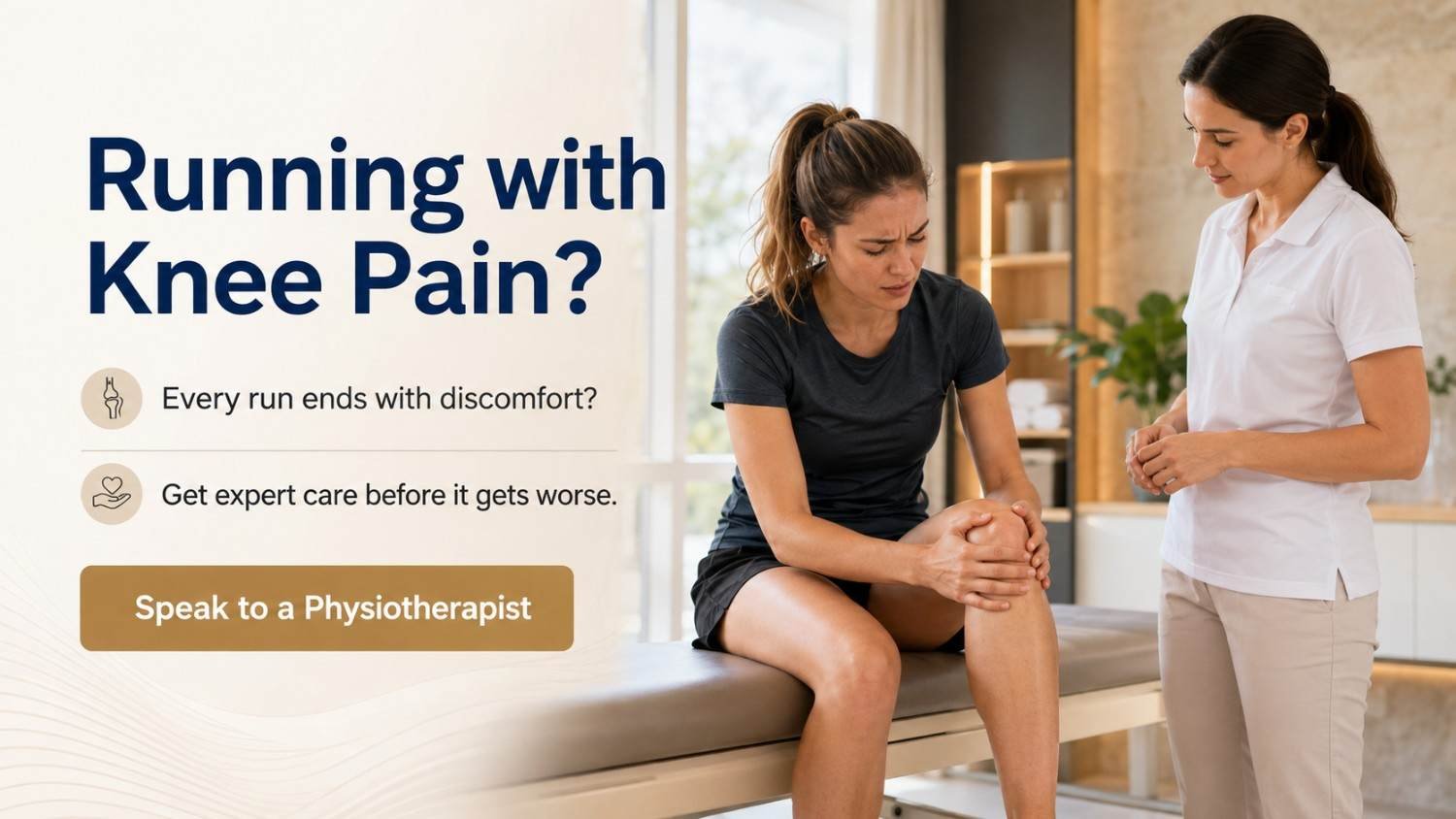

If your knee feels fine before a run but aches during the last few kilometres—or becomes sore after you stop—you are probably wondering whether to rest, change your training, or get it checked. Knee pain after running is common, but it is not a diagnosis. The location of the pain, how it started, what movements trigger it, and whether swelling or instability is present can point towards different causes.
For some runners, the problem follows a sudden increase in training. For others, knee pain after running may be related to patellofemoral pain, often called runner’s knee, IT band-related pain, patellar tendon overload, or another knee condition that needs assessment.
The useful question is not only:
“Why does my knee hurt after running?”
It is also:
“Why is my knee struggling with the amount of load I am asking it to handle?”
At PhysioVeda Medical Center in Dubai, a physiotherapy assessment can look at your knee as well as your hip and ankle strength, movement control, running mechanics and recent training load.
If knee pain is limiting your running, gym sessions, HYROX training or everyday movement, you can book an assessment at our Al Wasl (Jumeirah) or Al Karama clinic.
Quick Answer: Why Does My Knee Hurt After Running?
Knee Hurt After Running
In many cases, knee pain after running starts when training load rises faster than the knee and surrounding tissues can adapt.
This may happen after increasing mileage, adding hills or speed work, returning after a break, or combining running with demanding gym sessions.
Patellofemoral pain is one common pattern. It is usually felt around or behind the kneecap and can also be aggravated by stairs, squatting, jumping or prolonged sitting.
Clinical guidelines describe patellofemoral pain as pain around or behind the kneecap that is commonly aggravated by activities such as running, squatting and stair climbing.
However, pain around the knee is not always runner’s knee. Therefore, recurring symptoms should be assessed rather than self-diagnosed.
What Does the Location of Knee Pain Tell You?
Knee Hurt After Running

The location of knee pain after running can provide useful clues, although it cannot confirm the diagnosis on its own.
Pain Around or Behind the Kneecap
Front-of-knee pain around the patella is commonly associated with patellofemoral pain, often known as runner’s knee.
You may also notice discomfort during stairs, squats, lunges, jumping or after sitting with your knee bent for a long time.
If stairs are one of your main triggers, read our guide to knee pain while climbing stairs for a deeper explanation of possible causes.
Pain on the Outside of the Knee
Outer-knee pain during running may involve structures around the iliotibial band.
Some runners notice that the pain starts after a fairly predictable distance. It may also become more noticeable during longer or downhill runs.
Instead of repeatedly stretching the area without knowing the reason for your symptoms, it may be more useful to assess your running load, hip control, strength and mechanics.
Pain Below the Kneecap
Pain just below the kneecap may be related to patellar tendon overload.
This can become particularly relevant when running is combined with jumping, heavy squats, lunges, court sports or HYROX-style training.
Pain on the Inside or Back of the Knee
Inner-knee or back-of-knee pain can have several possible causes.
A clinician will usually want to know whether there was twisting, swelling, locking, catching, calf discomfort or pain during changes of direction.
New or unexplained pain behind the knee, especially when significant swelling is present, should be medically assessed.
Common Causes of Knee Pain After Running
Knee Hurt After Running

1. Runner’s Knee or Patellofemoral Pain
Runner’s knee is one of the most recognised explanations for knee pain after running.
Patellofemoral pain usually involves discomfort around or behind the kneecap and often becomes more noticeable during activities that repeatedly load a bent knee, such as running, stairs and squatting.
It is tempting to assume that the kneecap is simply “out of place.” However, the problem can be more complex.
Training load, knee strength, hip strength, movement control, tissue sensitivity and individual biomechanics may all influence symptoms.
Importantly, the 2024 best-practice guide for patellofemoral pain recommends exercise therapy and education as primary interventions. Knee-focused exercise is central, while hip-focused exercise and additional interventions can be selected according to the individual assessment.
That is one reason why a personalised rehabilitation plan can be more useful than randomly selecting exercises from social media.
2. A Sudden Increase in Training Load
Ask yourself what changed shortly before your symptoms started.
Did you recently increase your distance?
Did you add intervals?
Have you started running hills?
Did you move from running twice a week to four or five times a week?
Or did you return to training after several weeks or months away?
A rapid change in activity is worth reviewing when pain in knee after running begins without a clear traumatic injury.
Your cardiovascular fitness may allow you to run farther or faster, while your knee and surrounding tissues may require additional time to adapt to that workload.
This does not mean running is automatically bad for your knees.
It means progression matters.
3. Strength or Movement-Control Deficits
Running is essentially a repeated single-leg activity.
Every stride requires your hip, knee, ankle and trunk to manage and transfer load.
Therefore, when knee pain after exercise develops, assessing only the painful knee may not provide the whole picture.
A physiotherapist may assess your quadriceps and hip strength, single-leg control, calf capacity, ankle mobility and running mechanics.
Clinical guidelines for patellofemoral pain also support functional assessment using movements such as squatting, step-downs and single-leg squats.
This is why two runners with similar knee pain may eventually receive very different rehabilitation programmes.
4. IT Band-Related Lateral Knee Pain
If your knee pain when running is mainly located on the outside of the knee, lateral structures may need to be examined.
Training volume, downhill running and movement mechanics can all become relevant when trying to understand the pattern.
The answer is not necessarily to stop every form of exercise.
Instead, the aggravating load may need to be modified while strength and running tolerance are progressively rebuilt.
5. Patellar Tendon Overload
Patellar tendon pain is generally felt below the kneecap.
It can develop when repetitive running is combined with jumping, heavy lower-body training or rapid increases in activity.
This may explain why somebody develops knee pain after exercise even though the beginning of the workout feels comfortable.
Tendon rehabilitation commonly involves progressive loading. However, the programme needs to match the individual’s symptoms, capacity and training goals.
Why Does My Knee Hurt After the Run but Not During It?
Knee Hurt After Running
This is one of the most common questions runners ask.
Some people can complete a session with relatively little discomfort and notice knee pain after running later—while driving home, walking downstairs or standing up after sitting.
Symptoms do not always increase at exactly the same time as tissue loading.
The total stress of a training session may become more noticeable afterwards. In addition, stiffness after sitting can make an irritated patellofemoral joint or tendon feel more obvious.
However, delayed pain does not tell you the exact diagnosis.
What matters more is whether the pattern keeps returning, becomes progressively worse, affects normal daily activities or starts changing the way you run.
Knee Pain After Jogging: Does Pace Really Matter?
Knee Hurt After Running
You do not have to be preparing for a marathon to experience knee pain after jogging.
New runners may develop load-related symptoms when running distance or frequency is increased faster than their body has adapted.
The same principle applies when someone restarts exercise after several months away.
It can be tempting to return directly to the distance you used to run. However, your previous fitness does not automatically mean your current tissue capacity is the same.
Therefore, building frequency, distance and intensity gradually usually makes more sense.
If your knee begins hurting every time you jog, repeatedly resting until it feels better and then immediately returning to the same training volume can create a frustrating stop-start cycle.
That is when understanding the cause becomes more important than simply taking another week off.
Knee Pain After HYROX: Is Running the Only Cause?
Not necessarily.
Knee pain after HYROX can reflect the combined demands of running, sled pushes and pulls, lunges, wall balls and other high-volume lower-limb exercises.
Therefore, blaming only the running section may miss part of the problem.
If knee pain after running develops while you are preparing for HYROX, your overall weekly workload should be considered.
That includes your running kilometres, strength sessions, lunges, squats, competition simulations, recovery days and recent changes in training intensity.
Sometimes the answer is not removing one particular exercise forever.
Instead, running and strength loads may need to be reorganised while the knee’s capacity is progressively rebuilt.
If you regularly combine running with gym-based conditioning or competitive sport, explore our sports physiotherapy in Dubai service for sport-specific assessment, rehabilitation and return-to-training planning.
Knee Hurt After Running
Should You Keep Running Through Knee Pain?
Pain should not automatically make you afraid of movement. However, it should not simply be ignored.
If you have knee pain during running that changes your stride, becomes progressively worse or remains significant afterwards, reducing or temporarily pausing the aggravating running load may be sensible until the problem is understood.
The NHS advises runners not to continue running with a painful knee and recommends medical or physiotherapy assessment if symptoms persist.
Return-to-running decisions still need to be individualised because the cause and severity of knee pain differ from person to person.
When Is Knee Pain After Running a Warning Sign?
Knee Hurt After Running
Most running-related knee problems can be managed conservatively. However, certain symptoms deserve faster medical assessment.
Seek prompt medical attention if the pain follows a significant twist, fall or collision, or if you experience major swelling, inability to bear weight, marked loss of movement, obvious deformity, fever with a hot or red knee, or repeated locking or giving way.
A sudden pop followed by swelling or instability should also be assessed.
Hospital for Special Surgery similarly recommends medical review for severe pain, major swelling, inability to walk or limited movement following running-related knee pain.
If your symptoms started without an obvious injury but continue returning, you may also find our guide to knee pain with no injury useful.
How Physiotherapy Assesses Knee Pain in Runners
Knee Hurt After Running
A useful assessment for knee pain after running should involve more than simply asking where your knee hurts.
At PhysioVeda, an assessment may include your symptom history, recent changes in training, previous injuries, knee movement, strength, swelling and functional tests.
Depending on your symptoms, hip strength, ankle mobility, foot mechanics, single-leg control and running technique may also be considered.
For patellofemoral pain specifically, recognised clinical guidance supports functional tests such as squats, step-downs and single-leg squats alongside relevant strength and mobility assessment.
The objective is to understand what may be limiting your knee’s ability to manage your current running demand.
How Physiotherapy May Help Knee Pain After Running
Knee Hurt After Running
Treatment depends on the diagnosis and what is found during your assessment.
Load Management
You may not necessarily require complete rest.
Instead, running distance, intensity, frequency or terrain may temporarily be modified so that symptoms can be managed while your capacity is rebuilt.
The goal is to establish a manageable starting point and progressively work upwards.
Hip and Knee Strengthening
For patellofemoral pain, current evidence supports targeted knee exercise, with hip-focused strengthening added where appropriate.
Exercises may include variations of squats, step-ups, knee extension, split squats, hip strengthening and progressive single-leg activities.
However, the exercise selection and dosage should be matched to your symptoms and goals rather than copied from a generic online programme.
Running and Movement Retraining
Some runners may benefit from changes in running strategy.
Depending on the assessment, cadence, stride characteristics, hip control or other aspects of running mechanics may be considered.
Clinical practice guidance recognises running gait retraining as a possible intervention for selected runners with patellofemoral pain.
Importantly, there is no single “perfect” running style for everyone.
Therefore, running changes should be introduced for a specific reason rather than simply because someone’s technique looks different.
Gradual Return to Running
Once symptoms and physical capacity improve, running can be rebuilt progressively.
Distance, frequency, speed and hills do not all need to be increased at the same time.
If your situation involves ligament reconstruction rather than an overuse problem, read our guide on when you can start running after ACL surgery.
What Can You Do Right Now?
If your knee pain after running is mild and there are no warning signs, review what changed shortly before your symptoms began.
- Did you increase your running distance or number of weekly runs?
- Did you recently add hills, intervals or faster sessions?
- Did you start HYROX or heavier lower-body training?
- Did you return to running after a long break?
- Have your shoes or usual running surface changed?
- Is the pain now affecting stairs, squats, walking or sitting?
Temporarily reducing the activity that clearly aggravates the knee may help.
Ice may be used for short-term comfort if you find it useful, although reducing symptoms is not the same as identifying why those symptoms began.
Most importantly, avoid repeatedly testing the knee with hard runs simply to find out whether it still hurts.
When Should You Book a Physiotherapy Assessment in Dubai?
Consider booking an assessment if knee pain after running keeps returning, is becoming worse, limits your normal training or starts affecting walking, stairs, squatting or everyday activities.
You do not have to wait until running becomes impossible.
Assessment may help distinguish between runner’s knee, tendon overload, IT band-related symptoms, joint-related pain or another condition.
More importantly, it can give you a structured rehabilitation plan instead of several weeks of guessing which stretch, brace or exercise to try next.
For a broader overview of knee conditions, assessment and rehabilitation options, visit our Knee Pain Treatment in Dubai service page.
Why PhysioVeda for Running-Related Knee Pain in Dubai?
Running rehabilitation should be designed around the individual rather than just the painful joint.
At PhysioVeda Medical Center, physiotherapy assessment can consider your movement, strength, load tolerance and the physical demands of your training before rehabilitation is planned.
Our Dubai clinics support runners, gym-goers, active adults and people returning to exercise following injury. Depending on your findings, rehabilitation may involve exercise therapy, movement retraining, education and other clinically appropriate techniques as adjuncts.
Appointments are available at Al Wasl (Jumeirah) and Al Karama.
Still experiencing pain every time you run?
Instead of guessing what is wrong, book a physiotherapy assessment and understand what may be driving your symptoms before your next training block.
Call 800 8332 or book your appointment with PhysioVeda Medical Center in Dubai.
You can also follow @physioveda on Instagram for practical physiotherapy, movement and rehabilitation education. PhysioVeda’s website currently links to this Instagram profile.
Frequently Asked Questions About Knee Pain After Running
Why do I get knee pain after running but not while running?
Far far away, behind the word Mountains far from the countries Vokalia and Consonantia, there live the blind texts. Separated they live in Bookmark
Is runner’s knee the same as knee pain after running?
No. Runner’s knee usually refers to patellofemoral pain around or behind the kneecap. It is one common source of running-related knee discomfort, but IT band-related pain, patellar tendon problems and other conditions can produce similar symptoms.
Should I stop running if my knee hurts?
If pain is becoming worse, changes the way you run or remains significant after a session, repeatedly pushing through it is not a good strategy. The aggravating load may need to be reduced while the underlying problem is assessed.
Can physiotherapy help runner’s knee?
Physiotherapy is commonly used in the management of patellofemoral pain. Current evidence supports education and targeted exercise, particularly knee-focused exercise, with hip-focused exercise and other interventions selected according to individual findings.
How long does runner’s knee take to improve?
There is no single recovery timeline. Recovery can depend on how long symptoms have been present, their severity, your current training load, contributing factors and your response to rehabilitation. Progression should therefore be based on individual recovery rather than an arbitrary number of days.
Is knee pain after HYROX always runner’s knee?
No. HYROX combines running with several lower-limb strength and endurance exercises. Patellofemoral pain is one possibility, but knee pain after HYROX should be assessed rather than automatically labelled as runner’s knee.
What type of physiotherapist should I see for running-related knee pain?
A physiotherapist experienced in musculoskeletal or sports rehabilitation can assess the knee alongside running-related strength, movement and training-load factors. If a more significant injury is suspected, medical or orthopaedic assessment may also be recommended.
Take the Next Step
If knee pain after running is interrupting your training or keeps returning despite rest, consider having it assessed before simply increasing your mileage again.
A clear assessment and progressive rehabilitation plan can help you understand what your knee currently tolerates, what factors may be contributing to your symptoms and what needs to improve before your running load is progressed.
Book your knee physiotherapy assessment at PhysioVeda Medical Center in Dubai.
Call 800 8332 or book your appointment today.
Book a Consultation
It’s easy and free!
Tags:knee pain after exerciseknee pain after HYROXknee pain after joggingknee pain after runningknee pain during runningknee pain physiotherapist Dubaiknee pain specialist Dubaiknee pain treatment Dubaiknee pain when runningknee physiotherapy Dubaipain in knee after runningphysiotherapy for knee pain Dubairunner’s kneerunner’s knee treatment Dubairunning injuries Dubairunning injury physiotherapy Dubaisports physiotherapy Dubai