Looking for scoliosis treatment in Dubai? Physioveda offers DHA-licensed physiotherapy for children, teens, and adults with scoliosis, posture imbalance, back pain, uneven shoulders, and spinal curvature. Our non-surgical scoliosis physiotherapy approach focuses on posture correction, PPCM® assessment, scoliosis exercises, spinal strength, mobility, and long-term movement control.

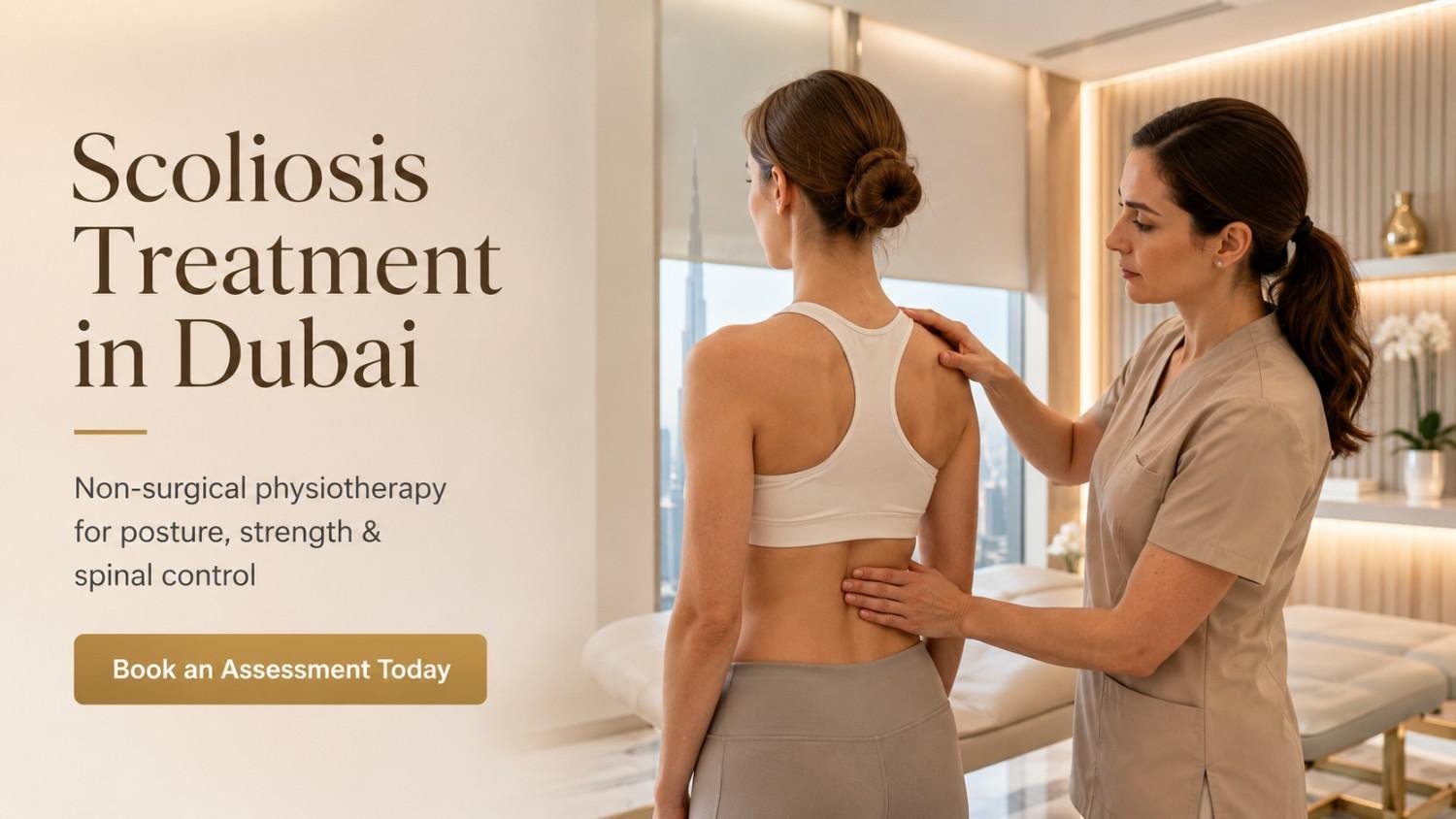
Scoliosis treatment Dubai has come a long way from a simple “wait and see” approach. If you have noticed one shoulder sitting higher than the other, a shirt that does not hang evenly, a visible curve in the back, or a nagging ache along one side of the spine, a structured physiotherapy assessment is often the first step toward better alignment, stronger movement, and safer long-term spine care.
At Physioveda Medical Center, our team of DHA-licensed physiotherapists helps children, teenagers, and adults understand the type of scoliosis they have and what can realistically be improved through physiotherapy. For many people, especially those with functional or posture-related scoliosis, a targeted programme may help improve spinal control, posture, muscle balance, pain, flexibility, and day-to-day movement.
This guide explains what scoliosis is, how it is assessed, the difference between structural and functional scoliosis, how physiotherapy may help, and how our Physioveda Posture Correction Matrix, PPCM®, supports scoliosis treatment in Dubai.
What Is Scoliosis treatment Dubai?
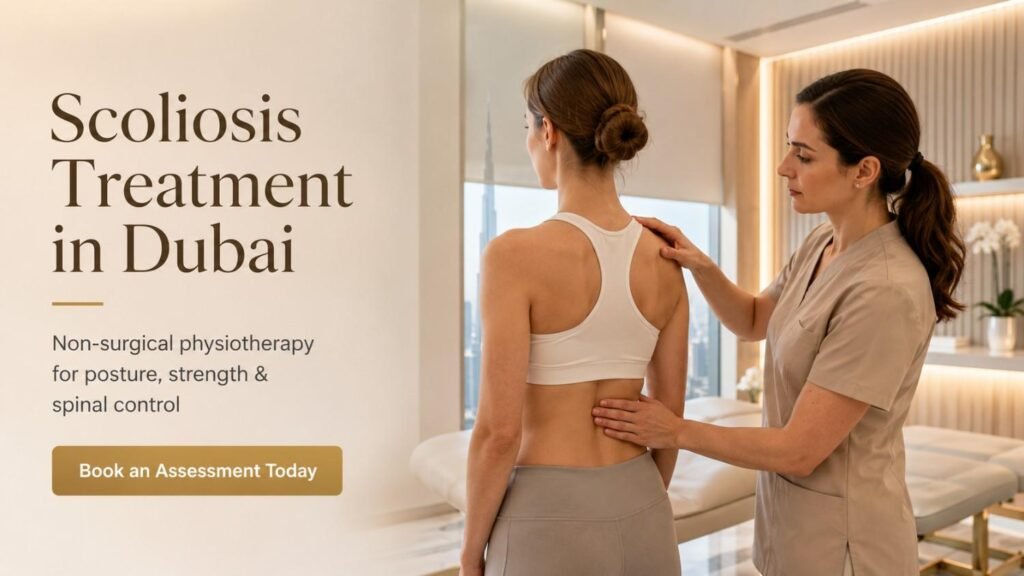
Scoliosis treatment Dubai is a side-to-side curve of the spine. From the back, a typical spine should look mostly straight. With scoliosis, the spine may curve into a “C” or “S” shape, and in many cases there is also a twist in the spine, called vertebral rotation. Mayo Clinic describes common visible signs such as uneven shoulders, one shoulder blade appearing more prominent, uneven hips, rib cage asymmetry, or one side of the back appearing higher when bending forward.
Many parents first notice scoliosis when a child’s school uniform, T-shirt, or sports jersey does not sit evenly. Adults may notice it because of persistent back discomfort, one-sided muscle tightness, uneven posture in photos, or fatigue after sitting or standing for long periods.
Scoliosis does not always cause pain, especially in children and teenagers. That is why a visible posture change should not be ignored just because there is no pain. A physiotherapy assessment can help identify whether the curve looks flexible, posture-related, muscle-related, or more structural and needs medical monitoring.
Why Early, Expert Care Matters For Scoliosis treatment Dubai
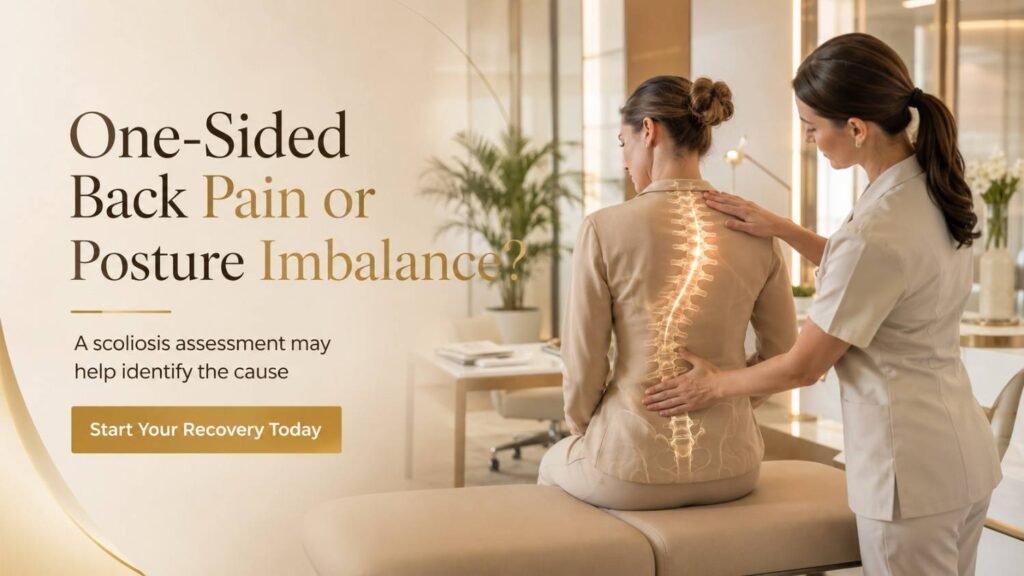
Early scoliosis treatment Dubai assessment matters because the goal is not only to look at the curve. The goal is to understand how the curve behaves, whether it is flexible or fixed, whether it is changing, and how it is affecting the person’s movement, posture, breathing pattern, pain, and daily function.
In children and adolescents, scoliosis can become more noticeable during growth spurts. Mayo Clinic notes that while most scoliosis is mild, some curves can worsen as children grow, and severe curves may affect breathing or require bracing or surgery.
In adults, scoliosis may be long-standing from adolescence or may develop gradually due to disc degeneration, spinal stiffness, muscle imbalance, work habits, or age-related changes. Adults often seek scoliosis physiotherapy in Dubai not because the curve is new, but because symptoms have started interfering with work, exercise, sleep, or confidence in posture.
The earlier the pattern is understood, the better the plan can be. A good scoliosis programme should not be random back exercises. It should be curve-specific, posture-specific, and based on the individual’s age, symptoms, flexibility, strength, and lifestyle.
Types of Scoliosis treatment Dubai: Structural vs. Functional
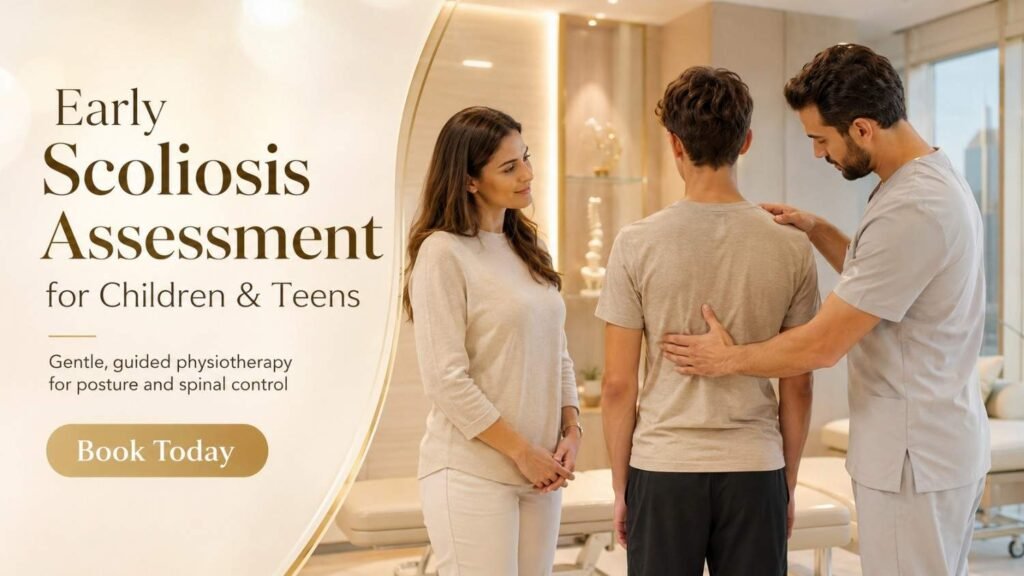
At Physioveda, we explain scoliosis to patients in two practical categories: structural scoliosis and functional scoliosis.
Structural Scoliosis treatment Dubai
Structural scoliosis is a fixed spinal curve where the bone structure itself is altered. The curve does not fully correct when the person changes position, bends, or lies down. Structural scoliosis may be linked to congenital spinal differences, neuromuscular conditions, or other spinal development factors. Many scoliosis cases, especially in children and teenagers, are idiopathic, meaning there is no single clear cause.
Physiotherapy may still be very useful in structural scoliosis, but it is important to be honest about expectations. A fixed structural curve may not fully straighten without medical or surgical intervention in severe cases. Physiotherapy focuses on reducing pain, improving function, improving posture control, strengthening spinal support, improving breathing mechanics, and helping prevent worsening where possible.
Functional Scoliosis treatment Dubai
Functional scoliosis is usually more flexible. It is often linked to muscle imbalance, posture habits, prolonged sitting, leg length difference, pelvic imbalance, weak deep core muscles, tightness on one side, or poor movement control.
This type is often also called postural or non-structural scoliosis. Because the spine itself is not fixed in the same way, functional scoliosis may respond very well to physiotherapy. With the right assessment, strengthening, mobility work, posture correction, and daily habit changes, many patients can see meaningful improvement in alignment, comfort, and movement confidence.
This is why assessment matters. Two people may both look like they have scoliosis from the outside, but the treatment plan can be very different.
Understanding Your Spine’s Support System for Scoliosis treatment Dubai
A strong scoliosis treatment plan should look beyond the visible curve. The spine is supported by several muscle layers, and each layer has a different role in posture and movement.
Superficial Muscles
These are the larger muscles closer to the surface. They help with bigger movements such as bending, rotating, lifting, walking, and general posture. When scoliosis is present, these muscles may become overactive on one side and underused on the other. This can create visible imbalance and one-sided tightness.
Intermediate Muscles
These muscles help the spine stay coordinated during movement. They support balance, control, and stability while the body transitions between sitting, standing, walking, lifting, or exercising. When these muscles are not working well together, the body may compensate through poor posture, uneven loading, or repeated strain.
Deep Core and Intrinsic Spinal Muscles
The deep spinal stabilizers are extremely important in scoliosis physiotherapy. These muscles control small spinal movements and help the spine stay stable segment by segment. Weakness or imbalance in this layer can make the spine less controlled, especially in functional scoliosis.
This is one reason generic gym exercises are not enough for scoliosis. Someone may have strong visible muscles but still lack deep spinal control. Scoliosis exercises need to train awareness, breathing, core control, back strength, pelvic stability, and curve-specific correction together.
Bone vs. Muscle: What Can Physiotherapy for Scoliosis treatment Dubai Actually Treat?
A trustworthy scoliosis clinic in Dubai should be clear about what physiotherapy can and cannot do. Scoliosis treatment Dubai.
For structural scoliosis, physiotherapy may not fully reverse the bone-based curve. However, it can still play an important role in reducing pain, improving posture, improving mobility, supporting breathing mechanics, improving strength, and helping patients function better. In surgical cases, physiotherapy may also be needed before and after surgery to support recovery, movement confidence, and functional restoration.
For functional scoliosis, physiotherapy may create more visible and functional improvement because the curve is often related to posture, muscle imbalance, pelvic alignment, ergonomics, or movement habits. Treatment focuses on strengthening weak muscles, improving flexibility, retraining posture, correcting movement patterns, and building better long-term spinal support.
This balanced approach matters. Scoliosis treatment is not about promising a perfect spine. It is about understanding the person’s curve, reducing avoidable strain, improving control, and helping the patient move with more confidence.
Scoliosis Treatment Dubai by Age Group
Scoliosis treatment Dubai should be adapted to age. A teenager, a desk-based adult, and an older adult with degenerative spinal changes do not need the same plan.
Children and Teenagers
In children and adolescents, scoliosis is often noticed during growth years. Parents may notice uneven shoulders, a rib hump when bending forward, one hip appearing higher, or clothes hanging unevenly. The Adam’s forward bend test is a common screening check used to look for rib or back asymmetry, but a complete assessment is needed before deciding what care is appropriate.
For younger patients, physiotherapy focuses on posture education, growth monitoring, curve-specific exercises, spinal mobility, deep core strengthening, breathing work, and safe home exercises. The goal is to support the spine during growth and reduce the chance of avoidable worsening.
Adults With Postural or Functional Scoliosis
Many adults in Dubai spend long hours sitting, driving, working on laptops, or training inconsistently. Over time, muscle imbalance, poor ergonomics, weak core support, and one-sided habits can create or worsen a functional spinal curve.
For adults with functional scoliosis, treatment usually includes posture correction, mobility work, manual therapy when appropriate, targeted strengthening, ergonomic coaching, and movement retraining. The focus is not only on the clinic session but also on how the patient sits, stands, sleeps, works, drives, and exercises.
Adults With Structural or Degenerative Scoliosis
Adults may also have structural scoliosis from adolescence or degenerative scoliosis due to age-related spinal changes. In these cases, physiotherapy often focuses on pain management, improving mobility, maintaining function, strengthening the spine and hips, improving balance, and reducing strain during daily activities.
Surgery is usually considered only for severe cases or cases with significant progression, neurological symptoms, or major functional impact. Mayo Clinic explains that scoliosis treatment decisions depend on factors such as curve severity, growth, symptoms, and whether bracing or surgery may be needed.
The Physioveda Posture Correction Matrix, PPCM®: Our Approach for Scoliosis Treatment Dubai
The Physioveda Posture Correction Matrix, PPCM®, is our structured posture correction system developed from over 20 years of clinical physiotherapy experience. For scoliosis, PPCM helps us look at the spine as part of a complete movement system, not as an isolated curve.
PPCM follows four key phases.
1. Full Postural and Movement Assessment
The first step is a detailed assessment. Our team of DHA-licensed physiotherapists checks posture, spinal movement, shoulder position, rib cage pattern, pelvic alignment, hip control, muscle tightness, weakness, balance, breathing pattern, and daily movement habits.
For scoliosis, we also look at whether the curve appears flexible or fixed, whether one side of the rib cage is more prominent, whether the pelvis is contributing to the curve, and how the patient moves during bending, walking, sitting, and standing.
2. Personalized Treatment Plan
After assessment, treatment is planned according to the individual. This may include manual therapy, spinal mobilization, targeted soft tissue work, postural correction techniques, mobility exercises, pain management strategies, and education.
The plan is not the same for every patient. A teenager with a flexible curve needs a different programme from an adult with long-standing stiffness and one-sided back pain.
3. Strengthening and Curve-Specific Control
Strengthening is a major part of PPCM. We focus on deep core muscles, back stabilizers, hip control, shoulder mechanics, and postural endurance. For scoliosis, strengthening must be specific. The aim is to improve control around the curve, not simply make the patient do general back exercises.
Where appropriate, we may include Schroth-based principles, three-dimensional correction concepts, breathing techniques, rib cage expansion work, and side-specific exercises to improve posture awareness and spinal control.
4. Long-Term Habits and Ergonomic Coaching
Scoliosis care does not stop at the clinic door. Long sitting hours, poor laptop height, one-sided bag carrying, weak exercise habits, and poor sleeping positions can keep feeding the same imbalance.
That is why PPCM includes ergonomic coaching, work posture training, lifestyle adjustments, home exercises, and long-term movement habits. The goal is to help patients maintain progress in real life, not only during physiotherapy sessions.
If you are looking for non-surgical scoliosis treatment in Dubai, a PPCM assessment can help identify whether your curve is mainly structural, functional, postural, or mixed, and what type of physiotherapy plan is appropriate.
Root-Cause, Whole-Body Assessment
Scoliosis is visible in the spine, but the cause of symptoms is not always limited to the spine. A whole-body assessment helps us understand why the curve is behaving the way it is.
At Physioveda, our scoliosis assessment may include:
Neck and shoulder mechanics, because shoulder asymmetry can make the curve look worse and can contribute to neck or upper back discomfort.
Rib cage movement and breathing pattern, because scoliosis can affect how one side of the chest expands during breathing.
Pelvic alignment, because a tilted pelvis can create or increase a functional curve.
Hip and lower body balance, because weakness, tightness, or leg length difference can affect spinal loading.
Work ergonomics, because Dubai professionals often spend long hours at desks, in cars, or on laptops.
Exercise technique, because gym movements, running habits, or one-sided sports can sometimes increase uneven loading.
This is why scoliosis physiotherapy Dubai should not be reduced to “do these five exercises.” The right plan starts with understanding the person behind the curve.
Benefits of Scoliosis Treatment Dubai
Scoliosis physiotherapy may help in several ways, depending on the type and severity of the curve.
It may help improve posture and alignment by teaching the body better spinal awareness and control.
It may reduce back, neck, shoulder, or hip discomfort linked to muscle imbalance and uneven loading.
It may improve flexibility and mobility, especially where one side of the spine, rib cage, hips, or shoulders feels restricted.
It may strengthen deep core and spinal muscles so the body can support the spine more effectively during sitting, standing, walking, lifting, and exercise.
It may improve breathing mechanics by working on rib cage mobility, thoracic movement, and controlled breathing patterns.
It may help reduce the risk of progression in selected cases, especially when combined with monitoring and appropriate medical guidance.
Results vary from person to person. The most important factors are the type of scoliosis, age, curve flexibility, symptoms, consistency with exercises, and whether the patient follows daily posture and ergonomic advice.
Who Can Benefit From Scoliosis Treatment Dubai?
Several groups may benefit from scoliosis treatment at Physioveda.
Adolescents
Teenagers with early signs of scoliosis may benefit from early correction, growth monitoring, strengthening, posture education, and curve-specific exercises. Parents often bring children after noticing uneven shoulders, one shoulder blade appearing more prominent, or a rib hump when bending forward.
Adults
Adults with scoliosis may benefit from physiotherapy if they have back pain, neck pain, one-sided tightness, posture changes, stiffness, reduced mobility, or fatigue from sitting and standing. Adults with functional scoliosis often respond well when posture, core strength, ergonomics, and movement habits are addressed together.
Post-Surgical Patients
Patients who have undergone scoliosis surgery may need physiotherapy to restore mobility, rebuild strength, improve confidence with movement, and return safely to daily activities. The programme should be guided by medical clearance and adapted to the surgical procedure.
Home Scoliosis Treatment in Dubai
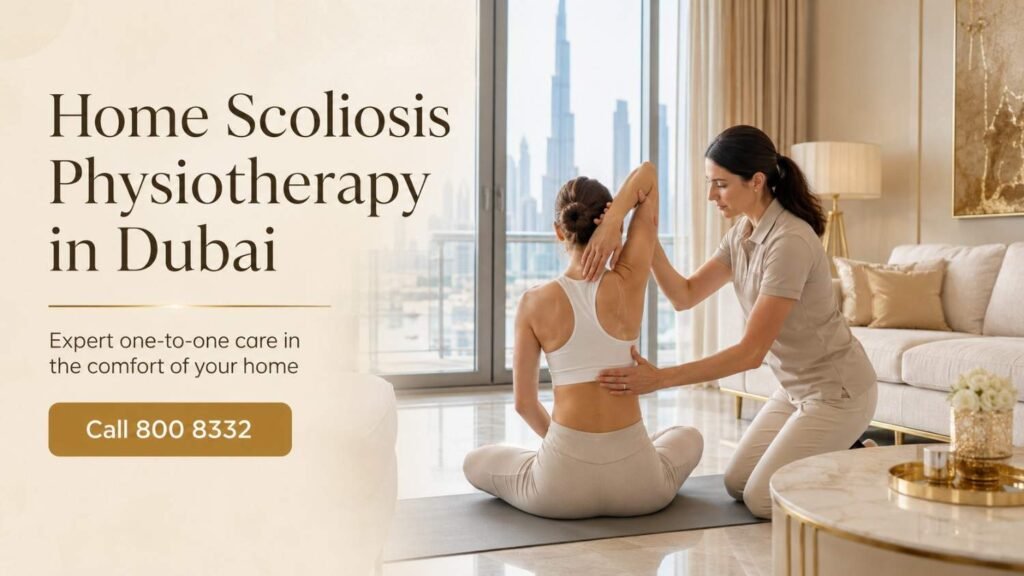
Physioveda also offers one-on-one home physiotherapy in Dubai for patients who prefer treatment at home or find travel difficult. Home scoliosis treatment can be especially useful for children, busy professionals, elderly patients, and post-surgical patients who need supervised care in a comfortable environment.
The advantage of home physiotherapy is that posture correction happens in the patient’s real daily setting. The physiotherapist can assess the actual work desk, sofa posture, sleeping setup, walking space, exercise area, and daily movement habits.
Home sessions may include assessment, pain management, guided scoliosis exercises, posture correction, breathing work, strengthening, mobility training, and ergonomic advice. The same clinical thinking is used, but the plan is adapted to the home environment.
To book home physiotherapy in Dubai for scoliosis, patients can contact Physioveda through WhatsApp booking or call 800 8332.
Why Choose Physioveda for Scoliosis Treatment Dubai?
Physioveda Medical Center offers scoliosis treatment in Dubai through a structured, clinically guided physiotherapy approach. Our team includes DHA-licensed physiotherapists, and Physioveda has been serving patients since 2019, with thousands of patients treated across two Dubai locations: Al Wasl/Jumeirah and Al Karama. Physioveda also works with major UAE insurance providers and offers same-day bookings, according to your clinic brief.
Patients choose Physioveda because the approach is not limited to symptom relief. The goal is to understand the curve, identify contributing muscle and movement patterns, improve posture control, and build a long-term plan that fits the patient’s age, lifestyle, work routine, and goals.
For scoliosis, PPCM gives the treatment structure: assess the whole body, create a personalized plan, strengthen the right muscle systems, and build better long-term habits.
Book a Scoliosis Assessment in Dubai
If you have noticed uneven shoulders, one hip higher than the other, a visible spinal curve, a rib hump when bending forward, or one-sided back pain, book a scoliosis assessment with Physioveda Medical Center.
Our DHA-licensed physiotherapists can assess your posture, spinal movement, muscle balance, flexibility, strength, and daily habits, then guide you on whether physiotherapy may help and what type of plan is suitable.
Book through WhatsApp or call 800 8332.
FAQs About Scoliosis Treatment Dubai
Can scoliosis be treated without surgery?
Yes. The majority of mild to moderate scoliosis cases, especially functional or postural scoliosis, may respond well to structured physiotherapy. Surgery is generally reserved for severe, rapidly progressing structural curves or cases with major functional impact. Our DHA-licensed physiotherapists carry out a full assessment first to understand the curve and guide the right approach.
What type of scoliosis needs surgery?
Surgery is usually considered only for severe structural scoliosis with large or progressing curves, or cases with significant breathing, neurological, or functional impact. Even when surgery is recommended, physiotherapy can still play an important role before and after the procedure to support strength, mobility, posture, and recovery.
Can functional scoliosis be fully corrected?
Functional scoliosis is caused by muscle imbalance, posture habits, pelvic imbalance, or movement patterns rather than a fixed bone deformity. Because of this, it often responds very well to physiotherapy. Many patients see meaningful improvement in alignment and symptoms, though results vary by individual and depend on consistency with the programme.
What is PPCM?
The Physioveda Posture Correction Matrix, PPCM®, is Physioveda’s structured posture correction system built on over 20 years of clinical physiotherapy experience. For scoliosis, PPCM combines postural assessment, manual therapy, core strengthening, breathing and rib cage work, ergonomic coaching, and Schroth-based correction principles into a personalized plan.
How long does scoliosis treatment take?
This depends on the type and severity of the curve, age, symptoms, flexibility, strength, and home exercise consistency. Some patients notice functional improvements within a few weeks, while meaningful postural change usually takes several months of consistent physiotherapy and daily habit correction.
Is scoliosis painful?
Mild idiopathic scoliosis, especially in children and teenagers, is often painless in the early stages. Pain is more common in adults, advanced curves, degenerative scoliosis, or functional scoliosis with muscle imbalance. Symptoms may include stiffness, fatigue, one-sided back pain, neck discomfort, or difficulty sitting or standing for long periods.
Because scoliosis can affect the full posture and movement chain, related concerns like back pain, sciatica, knee alignment, flat feet, and overall rehabilitation may also need attention. You can explore our related guides on sciatica treatment in Dubai: https://physioveda.ae/sciatica-treatment-dubai/, knee pain treatment in Dubai: https://physioveda.ae/knee-pain-treatment-in-dubai/, flat foot treatment in Dubai: https://physioveda.ae/flat-foot-treatment-in-dubai/, and rehabilitation physiotherapy in Dubai: https://physioveda.ae/rehabilitation-centre-near-me-in-dubai/. For posture tips, exercise education, and clinic updates, follow Physioveda on Instagram: https://www.instagram.com/physioveda/
Book a Consultation
It’s easy and free!
Tags:Adult Scoliosis Treatment DubaiBack Pain and Scoliosis DubaiBest Physiotherapy for Scoliosis DubaiFunctional Scoliosis Treatment Dubaihome physiotherapy DubaiNon Surgical Scoliosis Treatment DubaiPhysioveda Posture Correction Matrixposture correction Dubaippcm dubaiSchroth Exercises DubaiSchroth Method DubaiScoliosis Assessment DubaiScoliosis Clinic DubaiScoliosis Doctor DubaiScoliosis Exercises DubaiScoliosis Home Physiotherapy DubaiScoliosis in Children DubaiScoliosis Physiotherapy DubaiScoliosis Specialist DubaiSpinal Alignment DubaiSpine Curvature Treatment Dubaispine physiotherapy DubaiStructural Scoliosis PhysiotherapyTeenage Scoliosis DubaiUneven Shoulders Treatment Dubai